

For some years now, three letters have come up in almost every property conversation in France: DPE.
The DPE (diagnostic de performance énergétique) is the French energy performance certificate, the equivalent of an EPC: it rates every home from A to G. For some owners, it has become a source of worry. Others fear a steep discount on their property, and some even wonder whether it is still possible to sell an apartment rated F or G. If you own an older property in Nice, these are perfectly fair questions.
The good news is that a poor DPE does not condemn a property to sit on the market… or to be sold at any price. The reality is far more nuanced.
As so often in property, every situation is unique. The location, the type of property, the building, the scope for renovation and the kind of buyers it attracts matter just as much as the letter on the certificate.
So can you still sell an apartment rated F or G in Nice? Should you carry out works before selling? What discount do we actually see? And when can a new DPE change everything? Here is what you need to know before making a decision.
What the rules say: where do things stand today?
The rules on energy-hungry homes, often called “passoires thermiques” (literally “thermal sieves”), are changing step by step. The aim is to improve the energy performance of French housing, starting with the homes that use the most energy.
For letting: a gradual ban
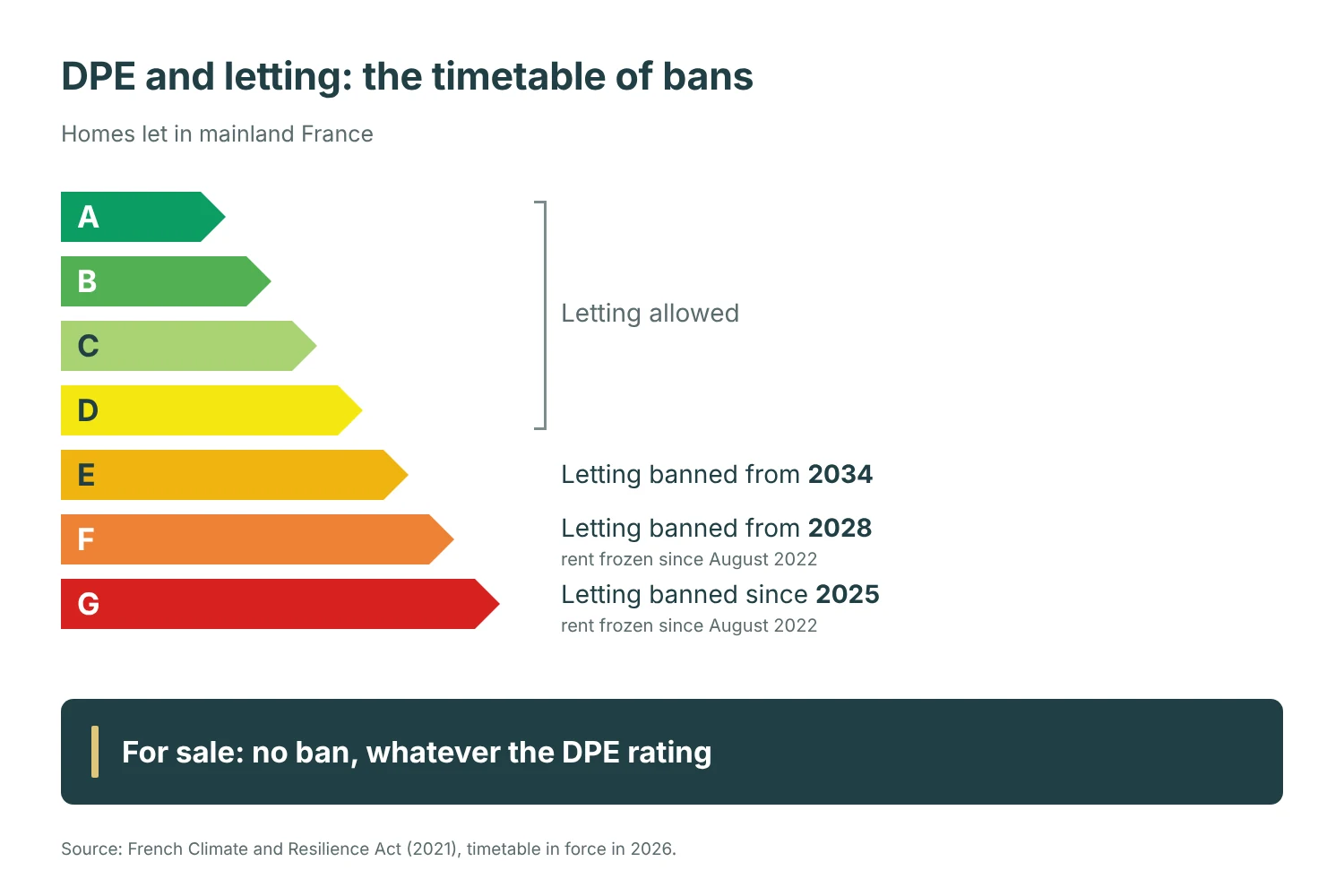
In practice, the main changes concern the letting of the worst-performing homes:
- since 1 January 2025, a home rated G can no longer be the subject of a new lease or a renewal;
- from 1 January 2028, the measure will extend to homes rated F;
- from 1 January 2034, it will apply to homes rated E;
- since August 2022, rents on homes rated F and G have been frozen.
In other words, a poor rating weighs mostly on an investor who wants to let, and very little, if at all, on a buyer purchasing a main home or a second home. As long as the property is not let, the impact of the DPE rating remains minimal.
For selling: no ban, but some obligations
A home rated F or G can still be sold. A poor DPE does not prevent the sale of an apartment or a house.
Some obligations do apply, however. The DPE must be valid and its rating shown in the listing from the start. And the sale of a house or a single-owner building rated E, F or G also requires an energy audit (this obligation does not apply to apartments in co-ownership buildings).
Before making any decision, it is therefore essential to check exactly which obligations apply to your property.
Does an apartment rated F or G necessarily lose a lot of value?
This is probably the question we hear most often. And the answer is simple: not necessarily.
There is no universal discount. Two apartments with exactly the same DPE can differ very widely in value. Why? Because the DPE is only one factor among many.
In Nice, an apartment in the Carré d’Or, in the Musiciens neighbourhood, in Cimiez or facing the sea will often keep attracting plenty of buyers despite a poor energy rating. Conversely, in an area where there is more on offer, a poor DPE may weigh more heavily in negotiations. The gaps between areas are set out in our guide to property prices in Nice, neighbourhood by neighbourhood.
The value of a property always depends on a combination of factors:
- its location;
- its general condition;
- its light;
- its view;
- the quality of the building;
- the service charges;
- the scope for renovation;
- and also… its asking price.
A correctly valued property generally finds its market. That is why it is better to analyse each situation individually than to apply an automatic discount. The right price from day one matters all the more: this is the whole question of the link between asking price and time on the market.
Renovate before selling… or let the buyer do the works?
Here again, there is no single answer. It all depends on the nature of the works, their cost and their real impact on the value of the property.
Some renovations do significantly improve energy performance while adding value to the home. Others are a major investment with no guarantee of an equivalent return when you sell.
It is also important to consider who your buyers are. Many prefer to buy a property slightly cheaper and carry out the works themselves, to suit their tastes, their needs or their budget. Others are looking for a fully renovated apartment, ready to move into.
Before committing several tens of thousands of euros to works, a tailored assessment often avoids spending that will not necessarily be reflected in the sale price. A few simple steps, on the other hand, often make the difference: these are our golden rules for preparing your property before a valuation.
When is it worth getting a new DPE?
This point is often overlooked. Yet it can have a big impact: not all DPEs are equal.
The calculation methods have changed in recent years, and some certificates no longer necessarily reflect the reality of the home:
- DPEs carried out before 1 July 2021 are no longer valid: the calculation method was completely overhauled;
- since 1 July 2024, the calculation has been adjusted for homes under 40 m², which had often been penalised until then;
- since 1 January 2026, electricity is penalised less in the calculation: according to published estimates, around 850,000 electrically heated homes have moved out of classes F and G, without any works.
Several other situations can justify having a new DPE carried out:
- insulation works have been done;
- the windows have been replaced;
- the heating system has been changed or air conditioning has been added;
- an error has been found in the first certificate;
- some features of the home were not properly taken into account.
A new certificate can therefore improve the property’s energy rating. Before putting an apartment up for sale, it is worth checking whether the DPE you have still matches the current situation.
Who still buys homes rated F or G?
Contrary to a widespread belief, homes rated F or G still find buyers, all the more so because in Nice properties rated G are rare, unlike in Paris for example.
Those who buy properties at the bottom of the scale include:
- investors who build the cost of the works into their plans;
- buyers who want to renovate their future home from top to bottom;
- property traders who specialise in renovation;
- first-time buyers prepared to make the necessary improvements gradually in exchange for a more affordable purchase price.
For these buyers, a poor DPE is not necessarily an obstacle. It is sometimes an opportunity to buy in a sought-after neighbourhood at a more attractive price. It is all a question of balance between the asking price, the cost of the works and the property’s potential.
5 mistakes to avoid when your home is rated F or G
1. Thinking your property has become unsellable
This is probably the most widespread misconception… and the most mistaken. Every week, homes rated F find a buyer in Nice. What makes the difference is above all how they are positioned on the market and the quality of their valuation. The DPE is now an important factor, but it does not wipe out the fundamentals of property: a sought-after location, a consistent price, a well-kept home or strong renovation potential still appeal to many buyers.
2. Rushing into expensive works
Changing all the windows, insulating the walls or replacing the heating system can sometimes make sense… but not always. In reality, it is rarely necessary to carry out works before selling: in most cases, you will never fully recover the cost. Before investing several thousand euros, it is better to assess the return on investment and work out whether the works really match what future buyers expect.
3. Setting your price on the DPE alone
The energy rating influences a property’s value, but it is never the only thing to consider, and buyers do not look only at the DPE. In Nice, the location, the light, the view, the floor, whether there is a lift, the service charges, the general condition and the potential of the home often have just as much impact on the sale price. The DPE is no substitute for an apartment’s charm, an open view or a well-run building.
4. Keeping an old DPE without checking it is still valid
After energy improvement works, or when the certificate is old, it may be worth having a new DPE carried out. In some cases, a little extra information or the new calculation method is enough to improve the energy rating.
5. Going with the first sales strategy without comparing the options
Selling as it is, carrying out a few targeted works, redoing the DPE or adjusting the price: there is no universal solution. Every property has its own strengths and every owner has different goals. Taking the time to look at the different options often avoids decisions made in a hurry… and gives a better result when you sell.
In short
- ✔️ Yes, a home rated F or G can be sold.
- ✔️ No, it is not always necessary to carry out works before selling.
- ✔️ The DPE influences the price, but never determines it on its own.
- ✔️ The right strategy often makes it possible to sell in very good conditions.
- ✔️ Every situation is different: a tailored analysis is still the best way to make the right decision.
Do you own a property rated F or G in Nice?
The DPE has profoundly changed the way buyers assess a property. Even so, it should not be seen as the end of the road. In Nice, many homes rated F or G still sell in good conditions when their marketing strategy fits the market.
The key is not to panic… but to make the right decisions at the right time. Redoing a DPE, carrying out certain works, selling as it is or adjusting the price intelligently: each solution depends above all on the features of the property and its owner’s goals.
A tailored analysis very often avoids costly mistakes… and lets you sell in the best conditions. That is exactly what a valuation of your property is for: at L’Agence M, it is free, backed by evidence and comes with no obligation, and it takes the DPE into account along with everything else. We also explain what a valuation really costs.